
Online assessment tool
Consulting Preference Profile CPP2
An online assessment of interaction styles for consultants, experts and professionals involved in projects. Discover how to adapt your behaviour to collaborate more effectively with stakeholders.
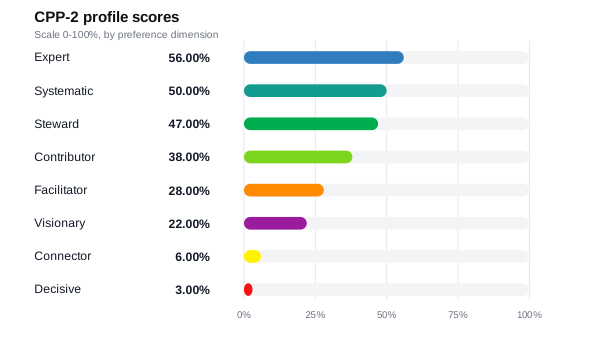
They indicate the styles a consultant tends to favour when able to choose.

Why does it matter?
Expertise is essential.
But it is not enough.
A consultant may recommend the right solution and still struggle to collaborate, because stakeholders do not all value the same things.
Some expect decisive recommendations, others look for detailed explanations, co-ordination, support, rigour or new ideas. The very same behaviour may inspire confidence in one stakeholder and resistance in another.
CPP2 helps consultants understand the behaviours they naturally prefer and when to adapt their approach to create value in each interaction.
Key questions
Why do stakeholders prefer working with you?
CPP2 provides insight into this question and several others that may be just as important.
What is the Consulting Preference Profile?
CPP2 is an assessment instrument for professionals working in business consulting, projects or technology consulting. It describes eight behavioural styles through which people relate to their clients and their own professional work.
What CPP2 is not
CPP2 is not a personality test, does not measure professional potential and does not classify people as ‘good’ or ‘poor’ at working with stakeholders. Scores indicate relative preference for particular consulting styles within an individual’s own profile.
Who is it for?
For professionals who contribute to successful projects.
CPP2 is relevant both to external client relationships and to teams providing internal expertise and consulting support.
Business consultants
Adapt conversations to sponsors, decision-makers and client teams.
Technology consultants
Make technical expertise valuable without losing sight of the needs of those involved.
Subject matter experts
Turn specialist knowledge into contributions that matter to stakeholders.
Project managers
Adapt their approach to co-ordinating, aligning expectations, negotiating and overcoming impediments.
Business analysts
Clarify requirements and facilitate collaboration between different perspectives.
Project teams
Improve collaboration with clients, colleagues and internal stakeholders.
The eight CPP2 styles
Every style creates value
In its own way
There are no inherently good or bad styles.
What matters is whether a style suits the context, risks and preferences of the stakeholder.
Steward
Listens carefully, clarifies needs and adapts the approach to what the client genuinely requires.
Contributor
Offers practical help, patience and availability without unnecessary pressure or conditions.
Connector
Builds genuine relationships, brings people together and strengthens trust throughout collaboration.
Facilitator
Simplifies complex initiatives, co-ordinates contributions and brings stakeholders into alignment.
Decisive
Reduces uncertainty through clear recommendations and ownership of direction when decisions must be made.
Visionary
Reframes challenges and opens up new perspectives when conventional approaches no longer work.
Expert
Brings sound reasoning, specialist depth and clarity to difficult decisions.
Systematic
Reduces risk through clear processes, checks and dependable follow-through.
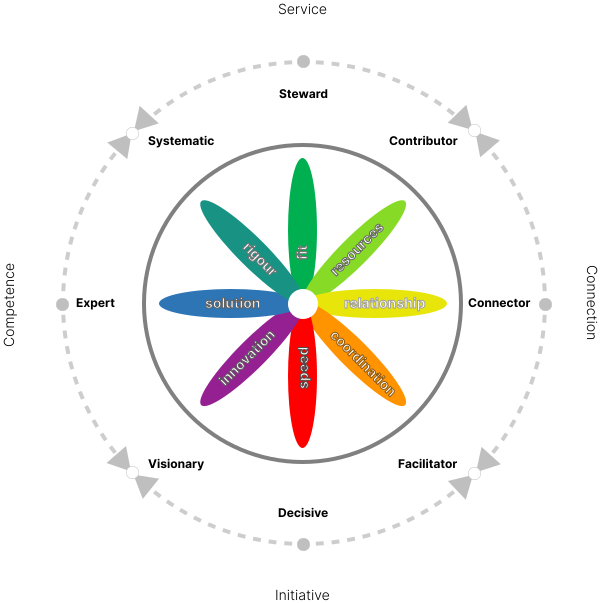
The CPPM circumplex
CPP2 is not just a list.
It’s a map.
The circular model arranges the styles around two fundamental questions:
Who takes the initiative? The consultant or the stakeholder?
What builds trust? Expertise and competence, or interpersonal connection?
Neighbouring styles share certain features, whereas opposing styles may represent approaches that create tension. The map helps put your preferences into context.
CPP2 is a practical tool for self-awareness, training and performance-oriented coaching.
Assessment benefits
What do you gain from understanding
your CPP2 profile?
Self-awareness is the first step. Practical value comes from expanding
your behavioural repertoire and knowing when to use it.
BEYOND NATURAL CHEMISTRY
Collaborate effectively even with people you do not naturally click with.
It is natural to work more easily with people who value your spontaneous style. CPP2 helps you recognise different expectations and adapt when preferences do not match.
Understand yourself better
Identify the styles you naturally favour, the motivations behind them and situations that may frustrate or demotivate you.
Adapt your behaviour
Make more deliberate choices about initiative, the way you make your case and the pace of an interaction, depending on the stakeholder.
Work beyond natural chemistry
Build productive working relationships with people who decide, communicate and operate differently from you.
Contribute more effectively to projects
Recognise when your approach moves work forward and when it may intensify blockages, tensions or delays.
Communicate more clearly
Calibrate the level of detail, listening and presentation of recommendations to reduce misunderstandings.
Use your strengths in moderation
Recognise when decisiveness feels like pressure, expertise overwhelms or rigour is perceived as rigidity.
It’s not about becoming someone else. It’s about having more behavioural options and knowing when to use them.
How does it work?
From self-assessment to a profile you can use
at work.
CPP2 uses an ipsative forced-choice format designed to minimise socially desirable responding
and reveal the relative ranking of consulting preferences
Complete it online
Respond to professional situations, selecting four preferred options from eight alternatives.
64 items
Eight dimensions across eight scenario groups, using forced-choice selections.
Style scores
Results highlight stronger, moderate and less preferred styles, as well as potential blind spots.
Individual PDF report
Receive an individual report featuring interpretations, examples and suggestions for development.
Deliverables
What you get with CPP2?
CPP2 gives participants a shared vocabulary for discussing behaviours, not for labelling people.
Consulting, delivery and project managers, as well as HR and L&D professionals, can use the results as a starting point for coaching, feedback and better collaboration.
The individual PDF report includes:
Optional services
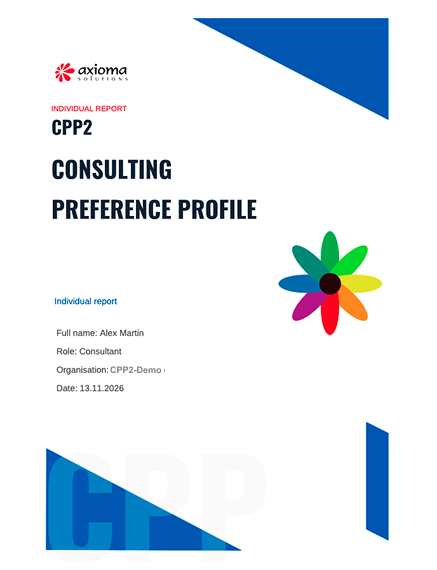
This illustration of the report cover is a sample,
not an extract from a real assessment.
Pricing
Choose the right assessment
for you or your team.
Choose the option that best matches your group size and the level of support
you need when interpreting the results
Individual assessment
For consultants, experts and project managers who want to explore their personal interaction profile.
per participant, excluding VAT
Includes online completion and an individual PDF report.
Team package
For consulting, specialist, delivery and project management teams with multiple participants.
Pricing depends on participant numbers and deliverables.
Assessment & workshop
For teams wishing to turn their CPP2 profiles into practical discussions about collaboration and stakeholder management.
Recommended workshop length: half a day to one day, tailored to team objectives.
Discover how to create more value in professional relationships.
Request a CPP2 assessment for yourself or your team. We will provide details about online access and the individual report.
Frequently asked questions about the Consulting Preference Profile
Answers to common questions about the CPP2 assessment, how to interpret its results and how it can be used.