
Online assessment instrument
Selling
Preference Profile SPP2
A clear picture of the interaction styles salespeople most frequently prefer when working with customers.
For training, coaching and developing greater behavioural flexibility in sales conversations.
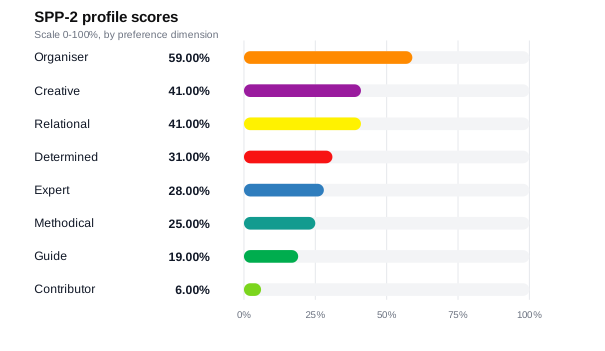
They show which styles a salesperson tends to favour when given a choice.

Why is it valuable?
It is not just what you sell.
It is how you relate to the customer.
The same behaviour can be perceived differently by two customers.
One customer may appreciate a quick decision, while another may resist the same firmness because they need clarification, attentive listening and a tailored approach.
SPP2 helps salespeople understand what they do and where they need to adapt their behaviour to create value in each interaction.
Essential answers
Why do customers prefer working with you?
SPP2 offers insight into this question, and several others that may be just as important.
What is the Selling Preference Profile?
SPP2 is an assessment instrument for sales professionals. It describes eight behavioural styles through which people relate to their customers and to their own professional work.
What SPP2 is not?
SPP2 is not a personality test, does not measure potential and does not classify people as “good” or “poor” at selling. Scores indicate relative preference for a selling style within an individual’s own profile.
Who is it for?
For sales professionals, sales managers
and HR/L&D teams.
Sales professionals
Understand which behaviours they prefer and how they can create greater value in customer relationships.
Sales managers
Gain a shared language for coaching, feedback and developing behavioural flexibility in selling.
HR & L&D professionals
Integrate the assessment into training, onboarding, development and assessment activities.
Trainers and consultants
Use SPP2 as a practical component of consultative selling, negotiation or account management programmes.
The eight SPP2 styles
Every style creates value
in a different way
There are no inherently good or bad styles.
What matters is how well an approach fits the situation, risks and customer preferences.
Determined
Reduces uncertainty through firm recommendations, taking responsibility for direction and bringing matters to a conclusion.
Organiser
Takes responsibility for alignment, organises the next steps and involves relevant people.
Relational
Builds personal trust, rapport and lasting commercial relationships.
Contributor
Offers availability, patience and support without pressure or conditions.
Guide
Clarifies the real need, listens carefully and tailors the solution to the customer’s requirements.
Methodical
Provides predictability, clear procedures, compliance and follow-through on commitments.
Expert
Persuades through knowledge, strong reasoning, evidence, comparisons and logical validation.
Creative
Helps overcome difficult situations through reframing, fresh ideas and differentiated solutions.
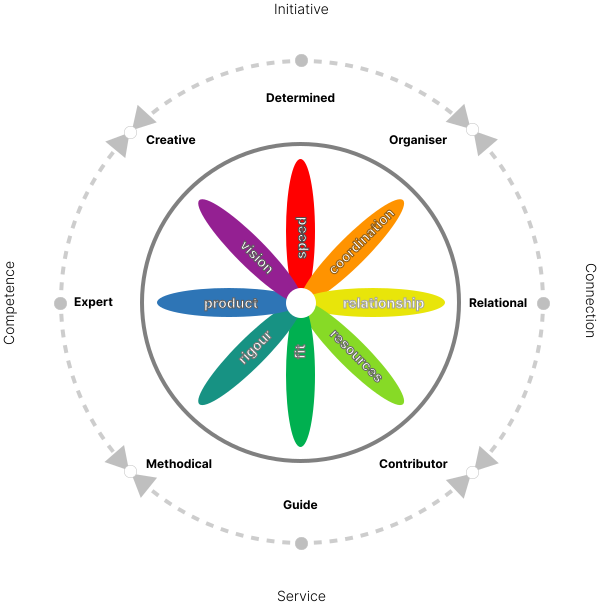
The CPPM circumplex model
SPP2 is not a list.
It’s a map.
In the circumplex model, the eight styles are arranged in a circle.
Neighbouring styles combine naturally, whereas opposite styles may create tension.
The vertical axis shows who takes the initiative in an interaction. The horizontal axis shows what trust is built upon — expertise or relationships.
SPP2 is a valuable instrument for self-awareness, sales training and coaching.
Benefits of the assessment
What do you gain from understanding
your SPP2 profile?
Understand what helps you succeed with some customers and what you could do differently to create valuable interactions with others.
Self-awareness is the first step; greater flexibility in customer relationships is the long-term benefit.
BEYOND NATURAL CHEMISTRY
Do not limit yourself to customers you click with straight away.
It is natural to find it easier to work with people who appreciate your usual style. SPP2 helps you recognise other preferences, adapt your approach and broaden your sales opportunities.
Understand yourself better
Discover the styles you use spontaneously, what motivates you and which approaches you tend to avoid. Learn why some interactions feel easy while others drain your energy.
Adapt your behaviour
Learn to recognise when customers want decisiveness, support, expertise, predictability or new ideas, and choose a suitable approach deliberately.
Communicate more effectively
Adjust the pace of the conversation, level of detail, arguments and degree of initiative. Reduce misunderstandings stemming from different styles.
Make the most of your strengths
Recognise when a strength may become excessive: firmness can feel like pressure, expertise can overwhelm and rigour can come across as inflexibility.
Become more flexible in selling
Identify less-preferred styles and situations where using them would be beneficial. Broaden your behavioural repertoire without changing your personality.
Build lasting relationships
When customers feel you understand their expectations and respect how they make decisions, you create the conditions for trust and long-term collaboration.
It is not about becoming a different kind of salesperson. It is about having more behavioural options and knowing when to use them.
How does it work?
A clear methodology, quick to apply
and a report designed for practical use.
SPP2 uses an ipsative, forced-choice format intended to reduce socially desirable responding and bring out the relative order
of interaction preferences in selling. It does not eliminate response bias.
Online questionnaire
Participants respond to professional scenarios relevant to customer interactions.
64 items
Items cover eight dimensions, grouped into eight professional situations.
Style-based scoring
Results identify higher, moderate and lower preferences, as well as less-used styles or potential blind spots.
PDF report
Each participant receives an individual report with interpretations, examples and development suggestions.
Deliverables
What do you receive?
The SPP2 report is designed for reflection, discussion and putting insights into practice quickly. Your individual PDF report includes:
Optional services
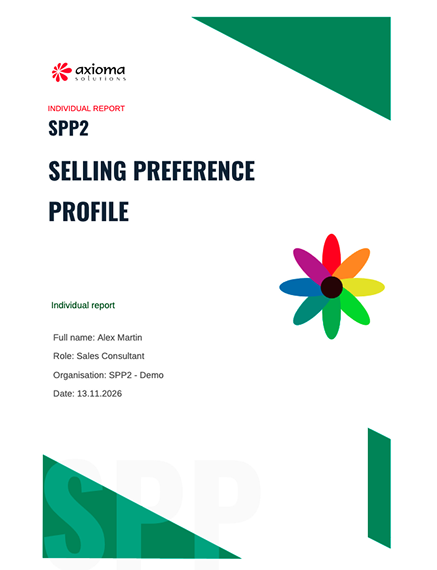
This illustration of the report cover is a sample,
not an extract from a real assessment.
Pricing
Assessment packages
for individuals and teams.
Choose the option that fits the number of participants and the level of support
you need to interpret the results.
Individual assessment
For individual participants or anyone wishing to try the instrument before a team project.
per participant, excluding VAT
Includes online completion and an individual PDF report.
Team package
For sales managers, HR professionals and consultants seeking insight into individual and team preferences.
Pricing depends on the number of participants and deliverables.
Assessment & workshop
For organisations wishing to translate assessment results into practical team learning.
Recommended workshop: half a day to one day, tailored to team objectives.
Would you like to understand how you or your team sell?
Use SPP2 to identify preferred interaction styles and develop a more flexible, better adapted and more valuable approach for your customers.
Frequently asked questions about the Selling Preference Profile
Answers to common questions about SPP2, how to interpret the results and how to use them.